
Understanding the Forex Market
|
|
|
|
MHFX RESOURCE CENTER Visit the Forex Trading Resource Center at MHFX
Get A FREE MHFX Practice Account
Test
Drive
the MHFX FOREXTrader Platform |
|
|
|
A true 24-hour market, Forex trading begins each day in Sydney, and moves around the globe as the business day begins in each financial center, first to Tokyo, London, and then New York. Unlike any other financial market, investors can respond to currency fluctuations caused by economic, social and political events at the time they occur - day or night. The Forex market is considered an Over The Counter (OTC) or “Interbank” market, due to the fact that transactions are made via an electronic network, not a trading exchange. Price fluctuations in currency exchange rates are determined through this Interbank system. Trading is not centralized on an exchange, as with the stock and futures markets. Orders are executed immediately and electronically from all parts of the world. Forex trading had been available to individual investors in other countries, but it was not until 1998 that individual U.S. investors could participate in the market. This created a whole new financial opportunity area, for which online trading is perfectly suited. It was quite literally the convergence of opportunity and new technology coming together at a key historic moment. Once Forex trading became available to retail investors in the U.S., the market greatly expanded. |
With a daily trading volume that is 50-times larger than the New York Stock Exchange, there are always broker/dealers willing to buy or sell currencies in the FX markets. The liquidity of this market, especially that of the major currencies, helps ensure price stability. Traders can almost always open or close a position at a fair market price.
|
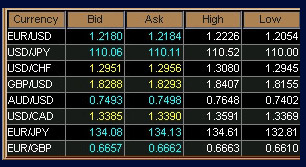
As with all financial products, FX quotes include a “Bid” and “Ask” (also called “Offer”) price. The Bid is the price at which a dealer is willing to buy (and clients can sell) the base currency for the counter currency. The Ask is the price at which dealers will sell (and clients can buy) the base currency for the counter-currency. The US dollar is the centerpiece of the Forex market and is normally considered the “base” currency for quotes. In the "Majors", this includes USD/JPY, USD/CHF and USD/CAD. For these currencies and many others, quotes are expressed as a unit of $1 USD per the other currency quoted in the pair. The exceptions to USD-based quoting include the Euro, British Pound (also called “Sterling” or “Cable”), and Australian dollar. These currencies are quoted as dollars per foreign currency as opposed to foreign currencies per dollar. |
 |
50:1 leverage is commonly available from online FX dealers, which substantially exceeds the common 2:1 margin offered by equity brokers, and 15:1 in the futures market. At 50:1, traders post $2000 margin for a $100,000 position, or 2%. Depending on the type of account, leveraging can be as much as 100:1, requiring only $1,000 margin. While certainly not for everyone, the substantial leverage available from online currency trading is a powerful, moneymaking tool. This is perhaps the greatest attraction to trading in Forex.
Incremental price movements in Forex are referred to as “pips,” rather than points. A pip stands for “price interest point.” Pip values vary based on the difference in exchange rates for a particular currency pair. Depending on the pair, this can vary anywhere from $7 to $14 per pip movement among the Majors, with the most popular pairs like EUR/USD and USD/JPY generally $10. In simple terms, if you trade EUR/USD on a “standard” sized account which uses the 50:1 or 100:1 to leverage, you will make or lose $10 for every pip that the pair moves. Mini-sized accounts have become popular over the past couple of years, because they offer a leverage that’s more comparable to stocks. In the same example, the mini account trader would make or lose $1 for every pip that the EUR/USD pair moves.
Another attraction for Forex traders are cost-efficient commissions and transaction fees. Commissions for stock trades range from $5.00-$29.95 per trade with online discount brokers and up to $100 or more per trade with full service brokers. This is separate from whatever additional fees may be charged for receiving live, real-time data. In the futures market, the average commission on a futures trade is $15 per round turn, plus additional transaction fees payable to the trading exchange, and NFA fees. These are taken from the client’s account regardless of whatever profit or loss they have from the actual trade. Forex commission structures are different. FX brokers derive their commission from the difference between the Bid and Ask price on every executed trade. There are no additional fees charged to receive live data, nor are there exchange fees. The account holder therefore pays no additional commission or transaction fees, regardless of the outcome of the trade, which is obviously attractive from the user’s perspective.