Market
Harmonics
Energy Watch
|
|
Market
Harmonics |
|
|
Different Directions for Crude Oil & Natural GasIn this edition of Energy Watch, we examine the Elliott Wave and sentiment evidence for further upside in crude oil, and a period of correction in natural gas. NYMEX Crude Oil
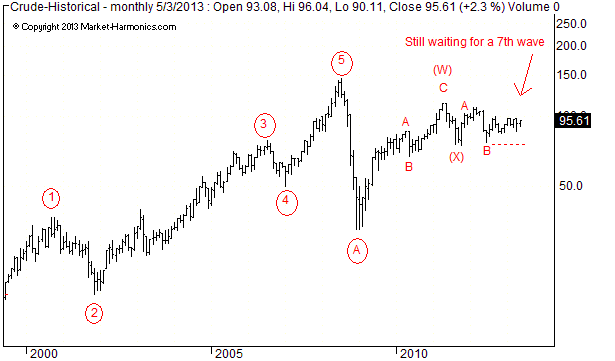
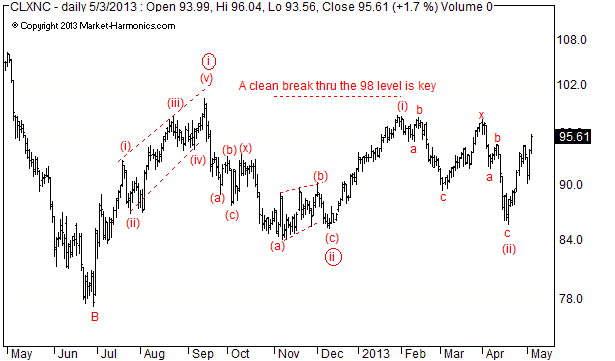
Refreshing our longer-term outlook for crude oil prices, we have waited (seemingly forever) for crude to post a seventh wave in its recovery from its late 2008 lows. While we continue to regard this advance as corrective and occurring within a secular bear market for crude, the expectation remains that in the more intermediate term, prices should still advance well above $100 before reversing to complete another leg down in the secular bear. Under this outlook, a final Wave C advance is therefore still expected, as outlined in the daily crude chart below.
Looking closer at the Elliott Wave patterns as we interpret them, crude would have traced out a pair of small degree first and second wave patterns, with the final down leg occurring on April 18th. If so, it would be set to launch a strong, upward third wave pattern that should finally take it through the $100 handle. Key to this occurring is for prices to surmount the $98 level, which has acted as resistance in previous attempts over the past year. A failure to do so may cause us to rethink our model, and while we have an alternate to consider, we'd prefer to see whether $98, and ultimately $100, can finally be overcome.
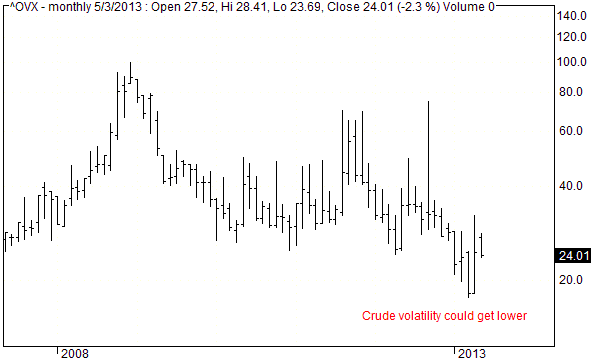
One reason to consider that prices might succeed this time in breaking through $98-$100 is in studying where current crude market sentiment is these days. The OVX is a volatility index that measures fear versus complacency as reflected in trading in the United States Oil Fund ETF (ticker USO). It is unto the USO what the VIX is to the S&P 500. As with all measures of sentiment, extremes of bearishness or bullishness ultimately give way to their opposite, and so we assume a contrarian view when looking at this data. While there is the suggestion of a possible bottom in volatility and the potential for a new rise (which would be bearish) there is in our view the potential for OVX volatility readings to still get lower. The main reason is that the Put/Call ratio for the USO is at 2-year highs, and is therefore not reflecting extreme bullish sentiment, but instead quite the opposite. The depth of put interest suggests traders and investors in USO are not looking for crude prices to get higher, but lower. The currently high reading in the ratio suggests bearishness may be getting extreme intermediate term, and that the crowd is betting wrong as it often does at inflection points. At this writing, prices have advanced 12% since the April 18th low, a good sign from a contrarian perspective; nevertheless, we still want to see crude prices successfully challenge $98-$100 level resistance to strengthen our thesis. NYMEX Natural Gas
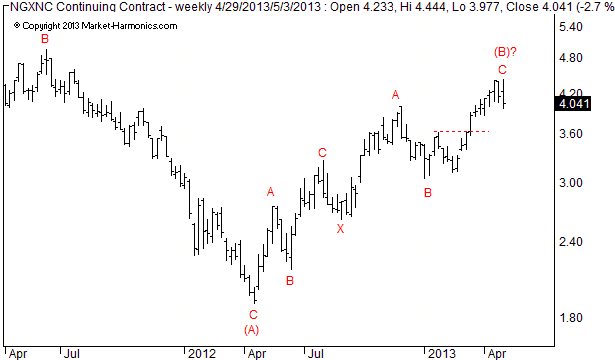
Referencing our comments from the previous Energy Watch, "while we are long-term bullish natural gas, we are still expecting a correction to unfold to retrace at least part of its advance since last April." This April saw prices push to a new recovery high in the $4.40's, which we allowed for, while still saying that although it might call for a revision to our Elliott Wave model, it would still not rule out an eventual reversal and potential for a deep correction. We now have some evidence to support a possible top in the post-April 2012 advance with the high made on April 19th. With respect to the Elliott Wave patterns, a double zigzag Wave (B) rally can be counted as complete from the April 2012 low. The only possible issue here is that the April 19th high can also be counted as the top of a third wave, so we cannot rule out an attempt to retest and exceed it in a fifth wave. Even so, prices are up against 61.8% Fibonacci resistance from the major price peak in January 2010, as well as 78.6% Fibonacci resistance from the June 2011 peak (Wave B in the upper left hand side of the chart) which preceded NG's slide to its lowest level in 11 years. Both are therefore likely to offer up some significant resistance. Thus, if an attempt at a new high is made, it is likely to prove short lived.
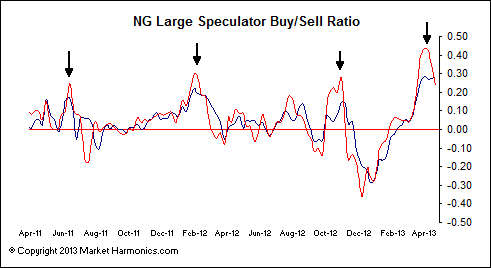
Another indication of a potential slide to further lows is from our proprietary Buy/Sell Ratio, a sentiment indicator derived from Commitments of Traders data to measure buying or selling pressure in futures contracts among Large Speculators (big institutions). Such speculators tend to be the most liquid part of the market. Each of the peaks in the indicator denoted by the black arrows was followed by a correction in natural gas prices. This sentiment measure thus further supports the case for at least some period of correction in NG prices.
Click here to view sentiment trends for Crude Oil & Natural Gas |
©Copyright 2013 Market-Harmonics. com. All content presented is the exclusive property of Market Harmonics. com, which is owned & operated by T. Carrion & Co., LLC, and may not be duplicated or distributed without the express written consent of the author.