
EQUITIES MARKET OUTLOOK (EMO)
|
|
EQUITIES MARKET OUTLOOK (EMO) |
January 28, 2008
Click the links below to proceed directly to the specific sections, or scroll through as you prefer. (Wave Watch reports are posted separately.)
Dow
Industrials
S&P 500
NDX
& QQQQ
Russell
2000 & IWM
Sentiment
View
Before proceeding, I wanted to thank the many of you who've written in to express your good wishes. It is sincerely appreciated. Although I've only met a few of you over the years, I consider the many of you who have been part of our growth over time as friends. So, I take your good wishes with me, and send my own to you. I founded Market Harmonics with the mission of helping people from all walks of life in their money-making, and remain committed to that mission. It's given me the chance to know people from all different parts of the world, which has been personally gratifying. So while I take this time to explore new opportunities, it is always with that fundamental mission in mind. Thanks again for making it both enjoyable and rewarding.
*****
At 6 billion shares, Monday's trading volume was what has become "average." Once upon a time, the AMEX was a small exchange, that maybe traded 100 million shares on a good day. Since 2003, the exchange has grown with the explosion of ETFs, and small bulletin board companies that came to the market via reverse merger and then listed on AMEX. In the past five years, AMEX daily volume has swollen ten-fold. NYSE volume has also doubled over that time, and now it appears official that the Big Board will get bigger via its proposed acquisition of AMEX, which is one of the few stock exchanges that still use the floor specialist system. The face of the market continues to change, and it's all the more interesting, considering the markets have likely hit a big fork in the road.
On Jan. 23, more than 12 billion shares were traded across the US stock exchanges, exceeding even the record reached on August 16. This probably qualifies as the "volume climax" I thought was needed to signal a low, although as we'll see in our discussion, we would ideally still see one more low made to then yield a stronger and better tradable rally. Along with volume, there are some significant trends in long and intermediate term momentum that are worth looking at.
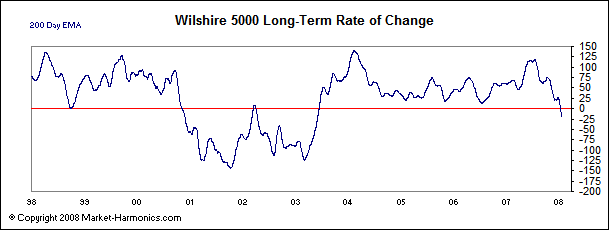
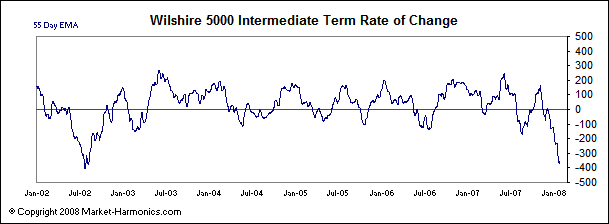
As the long-term rate of change for the Wilshire 5000 shows (top chart), momentum has turned negative, and reached its lowest reading since May 2002. The ROC uses a 200-day moving average, so this is not an insignificant negative cross. At intermediate scale, using a 55-day moving average, the ROC has been falling towards the levels reached in October and July 2002. This also has to be regarded as a key retracement. There is mounting evidence that the cyclical bull market has indeed topped, and that the secular bear market is reasserting itself. Consequently, it is not unreasonable to expect that these momentum readings should fully retrace, and ultimately exceed their 2002 readings.
Using the arbitrary definition, a bear market is confirmed with corrections of 20% or greater. Thus far, the Dow has corrected 18%, the SPX 19% (we won't split hairs here), the Nasdaq Composite 23% and the NDX 24% since their respective highs of October 2007. The RUT has also corrected 24% since its high of July. If we use the arbitrary definition, then on a percentage basis, a bear market across the stock averages is now in effect. On an Elliott basis, bear markets should fall in fives, and while they aren't the prettiest fives we've ever seen, we have nonetheless been seeing them. Unless a fundamental change in the wave patterns develop, then our presumption will be that the bear is on, and recoveries should therefore be regarded in that light.
Looking back on some Dow history, the early stages of the 1973-74 bear market were not "pretty pictures" of impulse patterns, yet declines were still making fives, even with overlaps. Once some real market fear kicked in, they became a lot more classically impulsive. That was a Cycle bear degree market, and it shaved nearly 50% off the Dow in less than two years. A Super Cycle degree bear could do even greater damage, particularly if it is accompanied by a "liquidity dry-up" courtesy of the credit crunch. Hopefully, the myth of the Fed's omnipotence will finally be seen for what it is. Even Alan Greenspan, who I ultimately came to respect, once stated that the idea the Fed could save the markets was "puzzling." Was anybody listening?
Dow Industrials
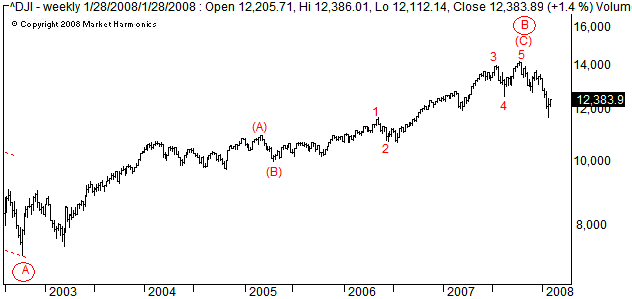
DOW CASH INDEX:
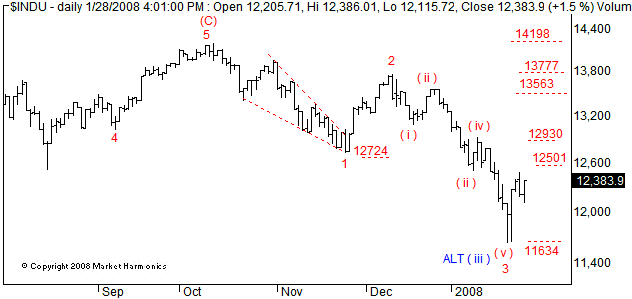
Based on the depth of the recovery thus far since January 22, I've made a minor
revision to our wave count for the Dow from last week, which allows for the low
at 11634 to be counted as either a Wave 3, or smaller degree Wave  under the ALT wave count. This makes a violation of 12501 that I spoke of
last week less significant. Trendline resistance also crosses the 12600
area. More significant for the larger wave count right now is a violation
of 12724. A violation here becomes more problematic, since it rules out a
more impulsive interpretation for the larger Wave (1) of Primary C. It
also throws the door open to varying interpretations as to how a further bear
market decline will unfold. For example, Wave (1) of Primary C may be
tracing out as a leading diagonal, or all of it could end up being a
diagonal. Since the selling hasn't been truly fear-based as yet, all the
choppy action makes a violation above 12724 possible. The most desirable
outcome for our model would be for the index to remain contained below 12724 and
make one more low to complete a full 5-wave impulse pattern in Wave (1), at
which point a better, tradable Wave (2) rally would emerge and play out over a
few months. Those who are more inclined to trade would then have the
opportunity to make money on both sides. Given the percentage depth of the
correction from October, we're not inclined to think that a retest of the high
would occur even in a strong Wave (2) rally. If it did, something else
would be developing.
under the ALT wave count. This makes a violation of 12501 that I spoke of
last week less significant. Trendline resistance also crosses the 12600
area. More significant for the larger wave count right now is a violation
of 12724. A violation here becomes more problematic, since it rules out a
more impulsive interpretation for the larger Wave (1) of Primary C. It
also throws the door open to varying interpretations as to how a further bear
market decline will unfold. For example, Wave (1) of Primary C may be
tracing out as a leading diagonal, or all of it could end up being a
diagonal. Since the selling hasn't been truly fear-based as yet, all the
choppy action makes a violation above 12724 possible. The most desirable
outcome for our model would be for the index to remain contained below 12724 and
make one more low to complete a full 5-wave impulse pattern in Wave (1), at
which point a better, tradable Wave (2) rally would emerge and play out over a
few months. Those who are more inclined to trade would then have the
opportunity to make money on both sides. Given the percentage depth of the
correction from October, we're not inclined to think that a retest of the high
would occur even in a strong Wave (2) rally. If it did, something else
would be developing.
DOW DIA-MONDS : The DIA-Monds still remain contained beneath resistance at 125.01, but the more important resistance continues at 127.24. If violated to the upside, then one or the other interpretations discussed above is of course applicable. Trendline resistance also crosses the 126 area.
DOW E-MINI FUTURES: For the March Dow E-mini futures contract, resistance continues at 12550, with 12823 remaining key to how we regard the decline pattern. Trendline resistance also crosses the 12600 area for the contract as well.
DOW SENTIMENT
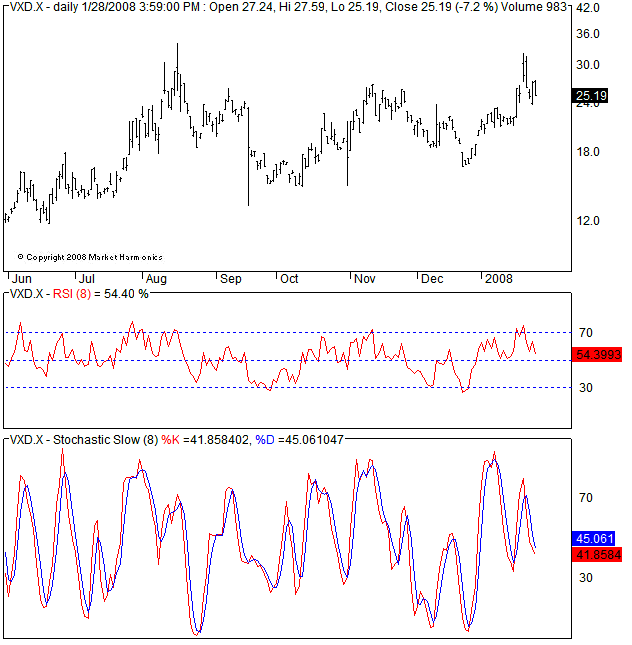
As the technical readings for the daily VXD suggest, Dow volatility has been retreating. Intraday readings have gotten much lower, so we could see similar volatility as was experienced on Monday. The issue is whether falling volatility might prevent the Dow from making the more ideal final low I discussed above.
S&P 500
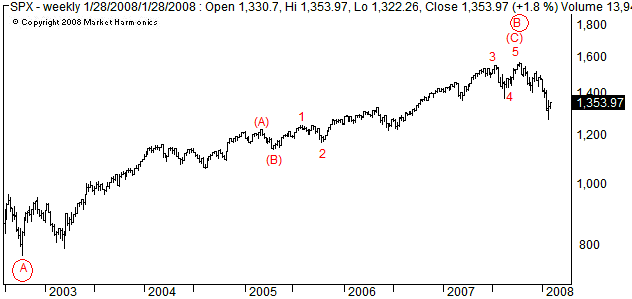
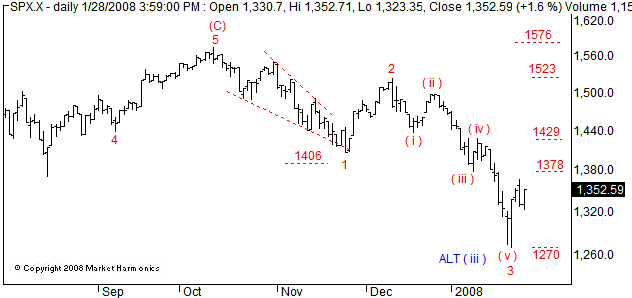
SPX CASH INDEX: I've similarly revised our wave labels for the SPX, as the interpretations for possible outcomes are basically the same as they are for the Dow. The additional low made at 1270 on Jan. 23 also makes either of the third wave counts possible, but with a preference for the higher degree Wave 3. 1378 should be regarded as resistance, but 1406 is more significant to the larger decline pattern. Most ideally, the recovery would remain below this level, and permit the index to make a better low at 1250 in a Wave (1) decline. A multi-month Wave (2) rally would then develop.
SPY-DERS: 137.72 continues as resistance for the SPY-ders, with 140.66 most significant for the outlook. 144 and 145.34 are higher resistance, though any break above 140.66 alters how we regard the recovery pattern.
SPX E-MINI FUTURES: For the March SPX E-mini futures contract, resistance continues at 1385, with 1416 most significant for the outlook. 1397 is additional resistance.
SPX SENTIMENT
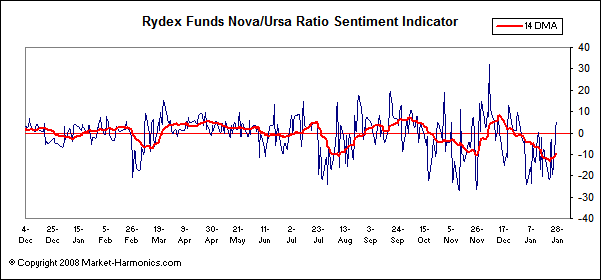
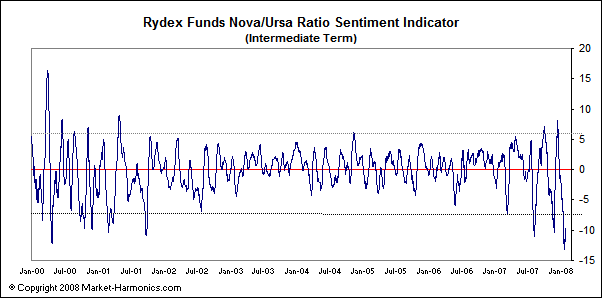
The current readings in both of our Rydex Nova/Ursa Fund indicators are rising, one reason we don't easily dismiss the possibility that the key resistance level in the SPX (and the Dow for that matter) could be hit. In the case of the long-term indicator, it is now rising off the lowest level ever reached, exceeding the "crash reading" of April 2000. It's worth noting that even though the indicator rose back then following the low, the SPX, along with the other stock averages, still continued to correct until the end of May 2000. Consequently, further lows in the SPX are not yet ruled out, and most ideally, we'd still see Wave 5 of (1) made to complete this leg of the bear market.
NDX & QQQ
NDX CASH:
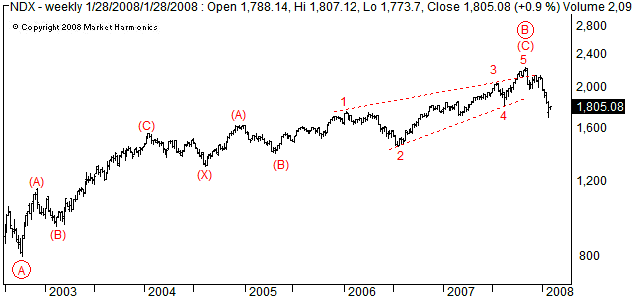
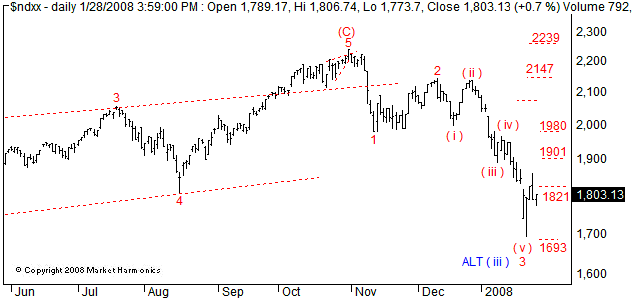
The wave labeling options for the NDX are, as we see, similar to what I've
modeled for the Dow and SPX, with the exception that a Wave
of 3 ALT count is somewhat stronger in the Naz. If that proves to be the
case, then we'd expect the current upside potential to be more limited.
Even so, we give weight to the prospect that the bigger Wave 3 of (1) ended
here. 1889 is softer resistance under this revised wave count, with 1980
being more significant in our ability to continue counting the decline as an
impulsive Wave (1). Any upside violation of 1980 becomes a challenge to an
impulsive wave count, though if the pattern remained a leading diagonal
triangle, it would nonetheless be bearish. Most ideally, the index would
continue to be contained below 1980 to complete Wave 5 of (1), and yield to a multi-month
Wave (2) rally. 1901 is additional resistance.
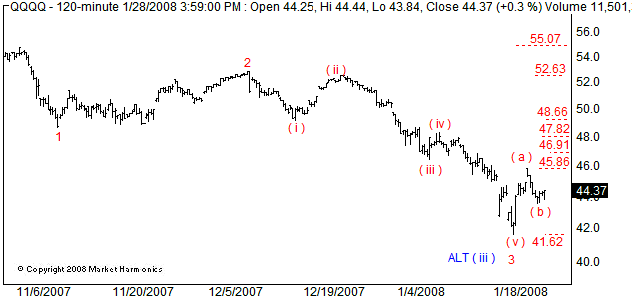
QQQQ: As the 120 minute chart of the Cubes suggests, the recovery should be developing as an ABC rally, that ideally would remain capped at 46.91, subsequently reversing to complete Wave 5 of (1). Alternatively, it could lead to a lower Wave 3. Either scenario is acceptable. A move above 48.66 in the current bounce would rule out the impulsive Wave 3 count and suggest a leading diagonal correction is more likely, which while a less than ideal outcome, is still ultimately bearish.
NDX E-MINI FUTURES: The March NDX e-mini futures contract retreated from low level Fibonacci resistance at 1873 on Friday, with 1903 still offering additional resistance. The contract needs to get above 2007 to rule out an impulse pattern, but not necessarily a new bear market low. More ideally, 1873 and 1903 would serve to contain the upside.
NDX SENTIMENT
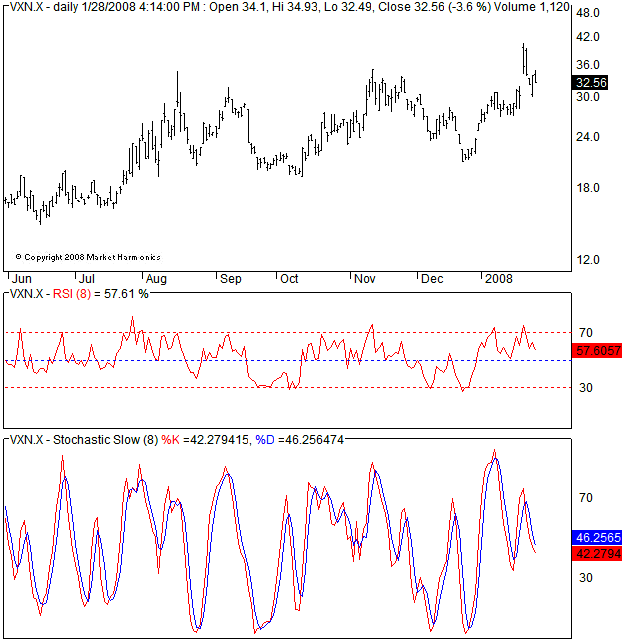
Low intraday technical readings on the VXN suggest we could see a possible uptick in volatility at daily scale. Even so, the daily readings still are withdrawing from their highest level since April 2003, and at this point it's too soon to say how significant that will prove to be.
Russell 2000 & IWM iShares
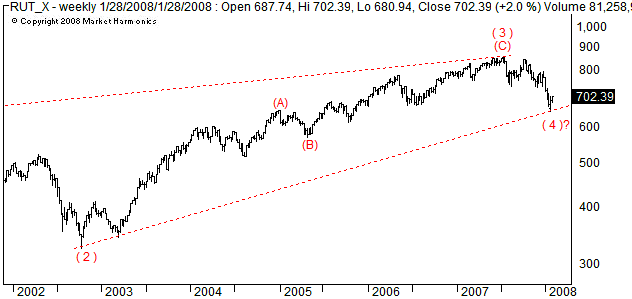
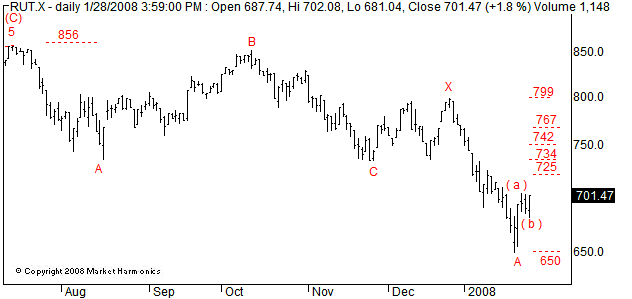
RUT CASH INDEX: I labeled a Primary Wave 4 low with a question mark in the RUT's long-running diagonal triangle. I doubt that this should be all of it, since at least one more leg down is implied to complete a full 7-wave correction from July. As I noted last week, how much upside the RUT manages in the current recovery is somewhat irrelevant, since the advance is countable as a Wave B, and only becomes an issue if it is strong enough to successfully retest 800. The best low for Primary 4 still occurs in the 500s. The most ideal model for now would be another low to complete a full Wave (W) decline, followed by a Wave (X) rally, to parallel the Wave (2) rallies discussed for the other averages. Again, this is the ideal, and we'll have to see what reality brings. Upside resistance areas are noted, with 799 the most key.
IWM
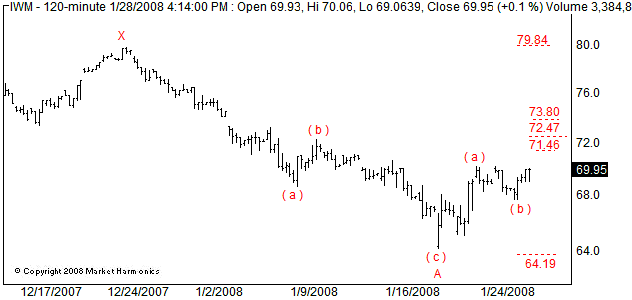
iShares: I've noted some upside targets for the Wave  of B rally in the IWM. The stock would need a move above 79.84 to change
the way we are modeling the correction, though most ideally we will still see
another low made to complete a full Wave (W) decline from the July highs.
of B rally in the IWM. The stock would need a move above 79.84 to change
the way we are modeling the correction, though most ideally we will still see
another low made to complete a full Wave (W) decline from the July highs.
RUSSELL E-MINI FUTURES: The March Russell E-mini futures contract tested 704 on Friday in its recovery, before withdrawing. 704, 721, 729 and 740 continue as resistance. Like the cash index, the contract needs a move above 800 to change the way we are modeling the correction, and argue for a Wave (W) low already in place.
RUT SENTIMENT
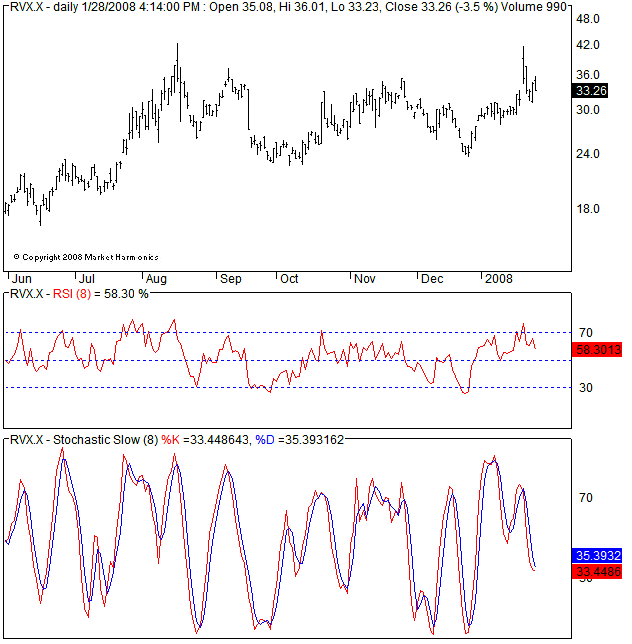
The daily technical readings on the RVX are essentially similar to those for the VXD and VXN, as all are withdrawing from high technical retracements. An uptick is still possible though, based on the already low intraday readings.
Sentiment View
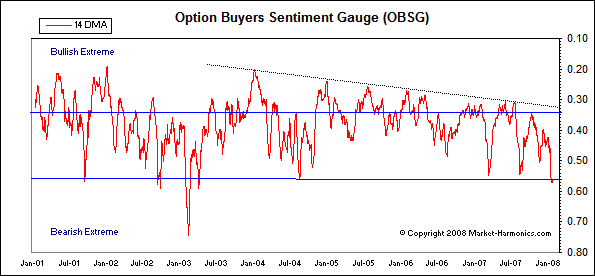
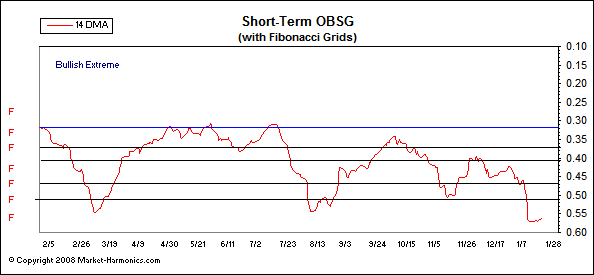
Looking at options sentiment via our OBSG indicator, the long-term chart reached its most bearish reading since the 9-11 attacks, and shorter-term indicator fell to levels associated with the stock market lows of March and August 2007. The OBSG attempts to render a neutral Put/Call reading out of divergent readings in the ratios for equity and index options. Recently, the ratios for both have gotten pretty divergent. Equity Put/Call readings are moving towards the most bearish readings seen in while, while those for index options are not even close to their equivalent bearish readings. The divergence reflects the same tendencies discussed last week between Large Speculators and Small Traders in SPX E-Mini futures, with the latter group displaying the most bearish trading patterns. Professional sentiment, as I've been noting recently, continues to be complacent. The evidence is seen not only here and in the futures market data, but in the Investors Intelligence data as well. There has been the tendency to refer to the Large Specs as the "smart money." As to their relative prescience or intelligence, I'm not inclined to award them more points, but instead acknowledge that the ability to move a lot more money does have the greater impact. Consequently, when that group becomes truly bearish, which I don't believe they are now, the markets would unravel even more sharply than we've seen over the past few months. It may still take one final blow-out rally for them to get there a la Wave (2), but if the bear is on, I've no doubt they eventually will.
Best
of luck always,
Tony Carrión
For the benefit of newer subscribers (and since we discuss options regularly) note our little shorthand: ATM = at-the-money options, ITM = in-the-money, and OTM = out-of-the-money.
©Copyright 2007 Tony Carrion. All content presented is the exclusive property of Market Harmonics. com, which is owned & operated by T. Carrion & Co., LLC, and may not be duplicated or distributed without the express written consent of the author.